
AI has been the talk of the town in public imagination for decades. Movies portray autonomous systems shaping society. But the reality is telling us another story: we are still early.
We are not living in an AI dystopia nor have we reached general intelligence. What we have reached is something more practical: narrow intelligence systems that work well when constraints are clear, incentives are aligned, and data flows are structured.
Looking back at the historical development of AI, the gap between early academic forecasts and real-world deployment is obvious. Progress has been uneven, cyclical, and heavily dependent on compute, data availability, and economic incentives. A useful reference point is the AI timeline compiled by Tableau, which shows that most commercially meaningful breakthroughs only occurred once infrastructure caught up with theory.
Where we are now: Agent Emergence, Not Singularity
We’ve moved past proof-of-concept chatbots. Today, AI agents are goal-driven systems that interpret inputs, plan actions, and execute within rule sets. They automate decision loops humans used to do manually not because they’re sentient, but because they can operate at scale, speed, and cost humans cannot match.
This is where crypto fits in: blockchains provide transparent state, programmable execution, and economic incentives precisely the primitives agents need to operate meaningfully.
The Rise of Agent Infrastructure
Today’s agents are only as effective as the infrastructure that supports them:
Perception layer: On-chain event feeds, oracles, indexers
Planning & reasoning: Models that translate goals into actions
Execution layer: MPC wallets, smart contracts, batching engines
Coordination layer: Messaging, logging, and accountability systems
This layered architecture is what separates toy demos from systems that can manage real value and crypto’s modularity accelerates this maturation.
AI Agent Adoption in Crypto
If we take a closer look to the rapid growth in crypto agentic systems:
According to Blockchain For Enterprise newsletter on AI agents in DeFi, the AI agent market jumped from ~$4.8B to ~$15.5B in crypto alone within three months of Q4 2024, with AI token market cap rising from ~$23B to ~$50.5B by early 2025.
Stablecoin-focused agent TVL on Base blockchain surpassed $20M by mid-2025, indicating meaningful capital committed to agentic workflows.
Projected global AI agent market growth is exponential, expected to reach $47.1B by 2030 from $7.6B in 2025.
These aren’t vague projections. They reflect capital deployment, token activity, and institutional interest, the very signals founders, builders, and strategists watch.
Why Crypto Accelerates AI Agent Adoption
While traditional finance has gatekeepers, NDAs, permissioned APIs, waterfall working styles, DeFi has the ideal conditions for autonomous systems and AI agents - open, programmable, and settles in milliseconds:
Permissionless execution: No centralized gatekeeper
Composability: Agents interact with protocols, wallets, and smart contracts
Economic finality: Actions settle with enforceable outcomes
Unlike Web2 automation, crypto agents can own keys, hold balances, and initiate transactions, removing coordination frictions and allowing native execution.
AI Agents Built for Web3: Virtuals
Aside from Fetch.ai, SingularityNET, and Autonolas, one of the most visible real-world implementations of agent infrastructure in crypto today is Virtuals.
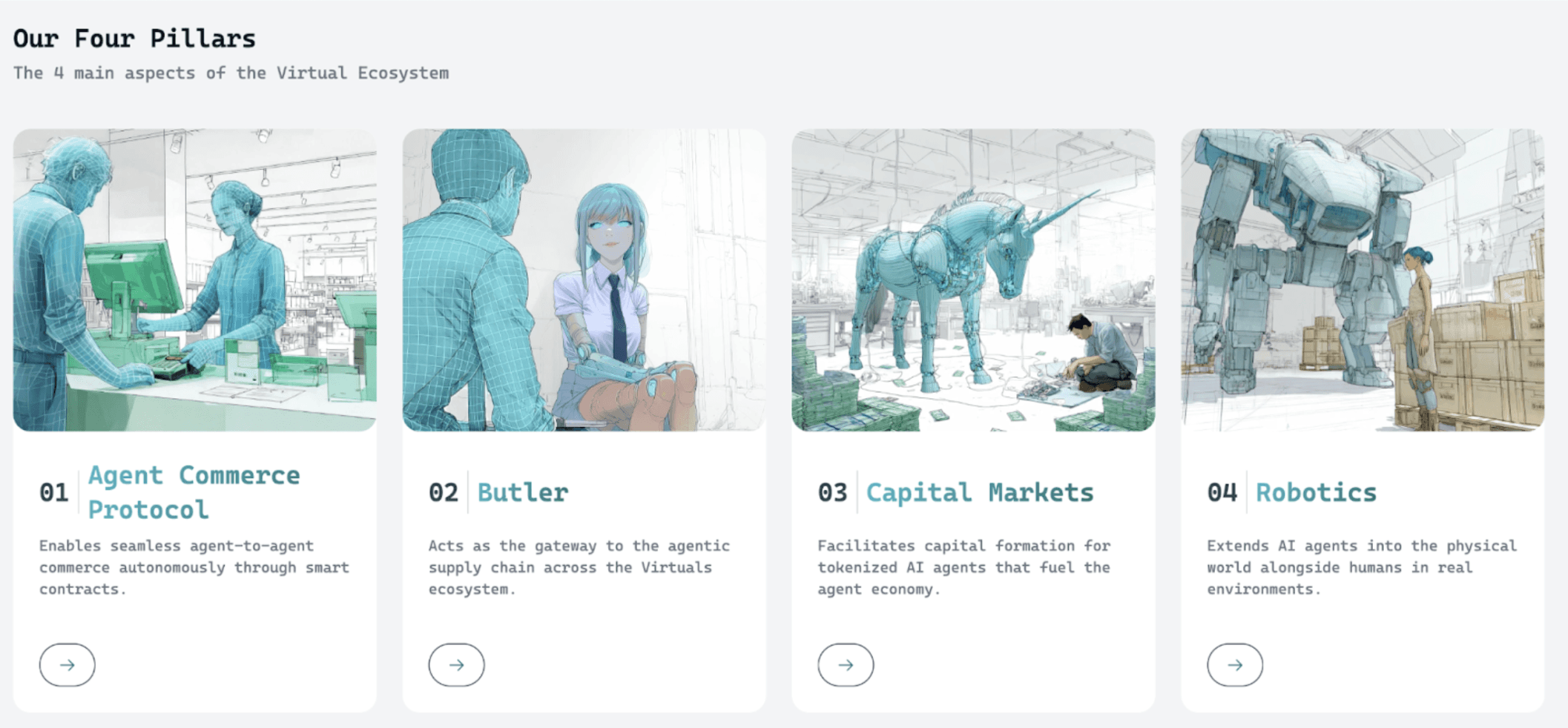
Virtuals enables autonomous AI agents that:
Interact with wallets and protocols via secure delegation
Monitor on-chain state and trigger actions based on defined strategies
Execute decisions in decentralized environments without human prompts each time
One more paragraph on thoughts about human role with the rise of Agent infrastructure
Their use cases include but are not limited to automated liquidity optimization across DEXs,
real-time portfolio rebalancing, event-triggered execution (liquidations, rewards capture), and even smart notifications to operators when thresholds are met.
What does this translate to economically?
Virtuals demonstrates what AI and Crypto infrastructure looks like when execution is native. AI Agents live where state, economics, and rules already exist on chain and they act with permissioned authority, not arbitrary autonomy. This has been proved with:
Over $100B+ in total value locked (TVL) continues to move across DeFi ecosystems (primarily on chains like Ethereum and Solana), creating a high-frequency, rule-based environment ideal for automation.
MEV, yield farming, and liquidity routing are already machine-dominated activities, AI agents are a natural evolution beyond static bots.
The broader AI agent market (across industries) is projected to grow at 30–40%+ CAGR, and crypto-native infrastructure is uniquely suited for autonomous execution due to programmable assets and transparent state.
The unsolved mystery: Where humans fit in this Agent-Driven World?

Execution alone is no longer sufficient; humans must focus on the ‘how’ and ‘why,’ defining intent and risk parameters at a strategic level. The original intention of autonomy is to increase human leverage and achieve something bigger. Instead of putting a close look at the executional, human, aka developers should start putting their efforts on training their AI model with high-level intent, constraint setting, and systemic risk management.
Agents don’t just automate execution, they also assist in shaping the strategy process. To activate our full potentials, we should start focusing on areas like:
Defining business constraints & objectives per request/ projects
Make custom auditing & alternations
Ensure not disclosing any confidential information to AI open source
Setting risk tolerances
Designing economic incentives
A Glimpse of AI Agents’ Limitation
Despite momentum, practical hurdles remain:
Fragmented data feeds need enrichment, not just access
Permission & key management requires rigorous guardrails
Regulatory ambiguity around autonomous financial execution persists
Economic alignment between agent actions and human goals is non-trivial
These are real engineering and operational constraints, not abstract theory.
Conclusion
AI agents have become active economic participants in crypto space: valuating markets, reallocating capital, and executing strategies at scales humans cannot match.
The data shows growth isn’t accidental. Adoption tracks with real capital flows, developer activity, and deployment patterns.
The bottleneck ahead is not intelligence. It is infrastructure maturity, who builds the rails that let agents operate safely, predictably, and within defined economic constraints.
That infrastructure will define the next era of AI × Crypto.
Explore More Reports
Discover additional insights and strategies across AI, growth, and M&A.