
Crypto has matured past its speculative adolescence. The 2026 M&A landscape shows fundamentally different from prior cycles. Buyers are no longer chasing narrative or token momentum. They are acquiring infrastructure, regulatory positioning, margin control, and distribution leverage.
Recent research across approximately 2,000 M&A transactions between September 2024 and March 2026 (spanning AI, crypto, fintech, and infrastructure sectors) reveals a clear pattern: crypto M&A is converging with consolidation trends seen across AI, fintech, healthcare, and enterprise software. This is not random deal flow, it is structural repositioning.
Deal velocity itself reflects this shift. Monthly deal activity across these sectors increased from ~30 deals in late 2024 to 80+ by early 2026, signaling a broader consolidation wave across emerging technology industries.
Large transactions further reinforce this transition:
Coinbase’s $2.9B acquisition of Deribit: the largest crypto M&A deal in this cycle, highlights institutional appetite for derivatives infrastructure and trading margin control.
Stripe’s $1.1B acquisition of Bridge reflects traditional financial players integrating stablecoin and crypto payment infrastructure into global payment rails.
Fireblocks’ acquisition of Tres Finance shows institutional custody providers expanding into automated credit and liquidity infrastructure.
These deals signal a structural shift: crypto infrastructure is being absorbed into the broader financial system.
From Speculation to Structural
The priorities of crypto buyers have changed dramatically since the previous cycle.
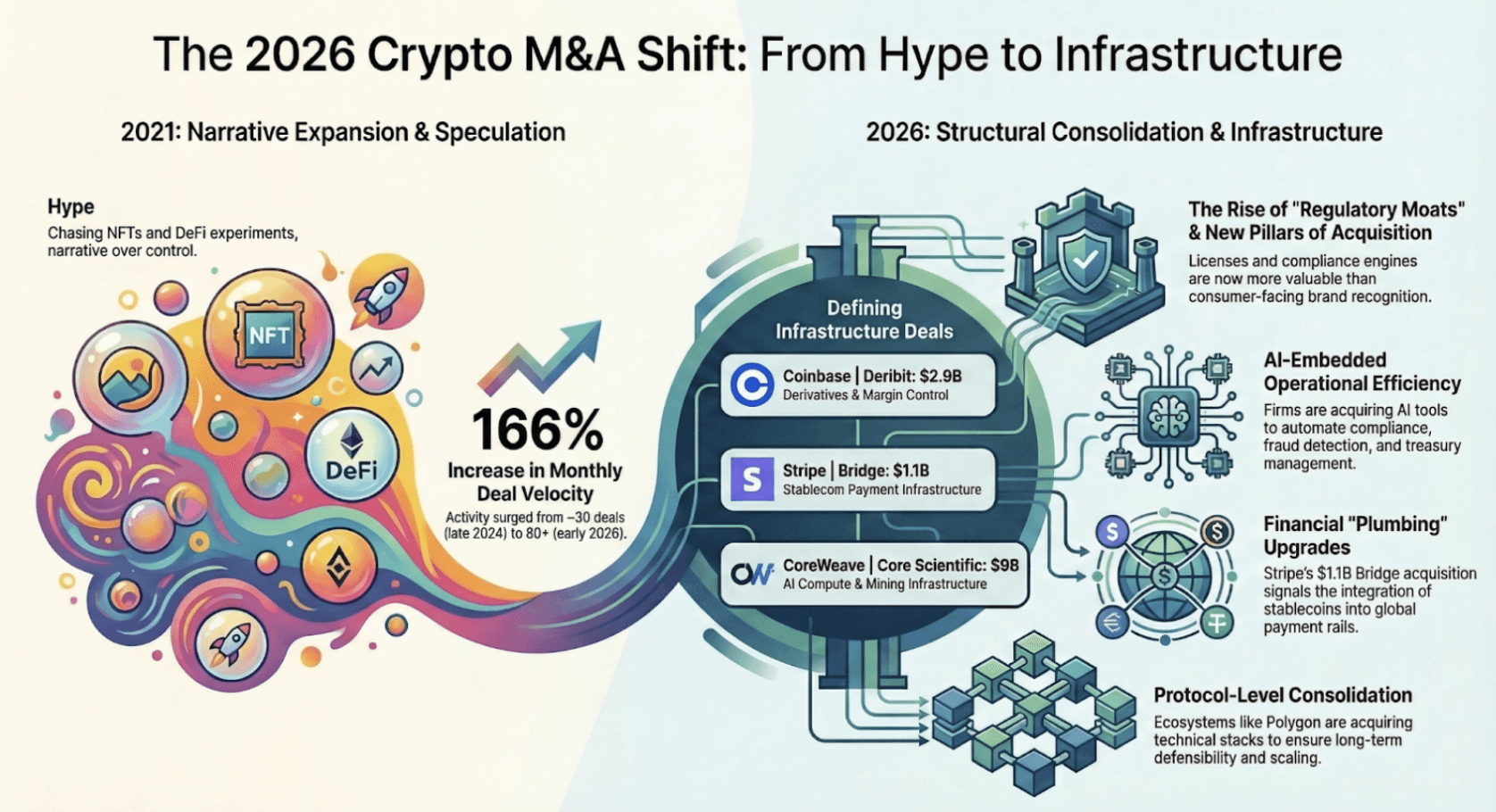
2021–2023: Narrative Expansion
Earlier M&A activity focused on growth metrics:
Token ecosystems
User acquisition
NFT marketplaces
DeFi experimentation
Ecosystem expansion
Acquirers were often chasing narrative momentum.
2024–2026: Infrastructure Consolidation
Today’s buyers prioritize defensibility and operational control. Across sectors, acquisition targets increasingly focus on:
Regulatory and compliance infrastructure
Margin consolidation through vertical integration
Institutional distribution channels
Embedded AI automation
Control over liquidity and execution layers
Crypto companies increasingly behave like financial institutions, SaaS platforms, and infrastructure providers, while traditional incumbents quietly absorb crypto capabilities into their existing operations.
Major M&A Themes Shaping Crypto in 2026
Analysis of recent deal activity reveals five structural themes shaping buyer behavior.
Financial Infrastructure Integration
Financial services remains the most structurally aligned sector with crypto M&A.
Observed patterns include:
Wealth and insurance platform roll-ups
Banks acquiring compliance and fraud technology
Private credit platform expansion
Embedded fintech infrastructure inside traditional finance
Crypto-specific acquisition priorities include:
Regulated custody infrastructure
Compliance automation (KYC, AML, identity verification)
Risk analytics and fraud detection
Lending and credit underwriting engines
Stablecoin payment rails
Key Deals
Coinbase / Deribit: derivatives infrastructure consolidation
Stripe / Bridge: stablecoin payment rails entering traditional finance
Fireblocks / Tres Finance: liquidity and credit automation
These acquisitions represent financial plumbing upgrades, not speculative bets.
Targets are often niche infrastructure startups, compliance SaaS, liquidity engines, and lending platforms, rather than consumer-facing crypto brands.
2. Artificial Intelligence Embedded in Crypto Infrastructure
AI M&A across the broader technology sector has shifted away from foundation models toward vertical integration into operational workflows.
Large companies are acquiring:
Vertical AI tools
Data infrastructure
Workflow automation platforms
Crypto firms are following the same playbook. AI capabilities being integrated include:
AI-driven compliance monitoring
Fraud detection and transaction surveillance
Market surveillance automation
On-chain analytics
Risk modeling for trading and lending
The goal is operational automation. Crypto companies are not acquiring AI research labs. They are acquiring AI tools that plug directly into trading, custody, compliance, and treasury management systems.
3. Software, Identity, and Security Infrastructure
Enterprise software consolidation is also influencing crypto M&A.
Across technology markets:
Cybersecurity acquisitions remain persistent
Vertical SaaS specialization continues
DevOps and cloud infrastructure deals remain active
Identity management tools are increasingly strategic
For crypto firms, these capabilities are foundational. Common acquisition targets include:
Identity verification systems
Wallet infrastructure providers
API and developer infrastructure
Security audit platforms
Cloud-native scaling infrastructure
Example: Protocol-Level Consolidation
Blockchain ecosystems themselves are now consolidating technical capabilities.
Polygon Labs, for example, has executed multiple acquisitions to expand its infrastructure stack and developer tooling. These moves reinforce a broader trend: protocol teams are increasingly acquiring core technology instead of building every layer internally.
The objective is ecosystem defensibility.
4. AI + FinTech Convergence
One of the most powerful cross-sector trends is the convergence of AI and financial services.
Across the enterprise landscape, AI is being deployed to:
Automate underwriting
Improve fraud detection
Optimize portfolio risk models
Enhance liquidity management
Crypto-native applications include:
Automated treasury management
Smart routing and execution optimization
Stablecoin risk monitoring
AI-driven portfolio rebalancing
Liquidity provisioning optimization
The typical acquirers in this category include:
Crypto exchanges
Institutional trading desks
Stablecoin issuers
Digital asset asset managers
FinTech infrastructure providers
These capabilities transform crypto from speculative trading infrastructure into programmable financial automation systems.
5. Infrastructure, Compute, and Industrial Signals
Crypto infrastructure is increasingly intertwined with broader industrial trends.
Large deals in adjacent sectors, including semiconductors, energy, and compute infrastructure, highlight macro positioning.
Examples include:
CoreWeave’s $9B acquisition of Core Scientific, linking AI compute demand with crypto mining infrastructure
Marvell’s $3.25B acquisition of Celestial AI, reflecting the strategic importance of AI hardware infrastructure
Implications for crypto include:
Mining economics tied to AI compute demand
Blockchain nodes increasingly competing for data center resources
Hardware supply chains influencing blockchain infrastructure
Crypto is no longer isolated from industrial cycles. It is becoming part of the broader compute and financial infrastructure stack.
What Buyers Are Actually Looking For in Crypto 2026?
Across these categories, priorities converge on:
Regulatory Moats: Licenses, compliance engines, identity infrastructure, and regulatory reporting systems are increasingly valuable.
Margin Control: Vertical integration of custody, routing, clearing, and execution layers helps protect trading margins.
AI-Embedded Efficiency: Automation of compliance, fraud detection, and liquidity optimization reduces operational cost.
Distribution Expansion: Access to institutional clients, banking partnerships, and wealth management channels is a major acquisition driver.
Capital Leverage: Lending platforms, stablecoin issuance, and credit systems provide leverage across crypto financial markets.
Speculation is no longer the driver. Defensibility and efficiency are.
If Fireblocks represents institutional consolidation, Polygon Labs represents protocol-level consolidation. By acquiring multiple companies in quick succession, Polygon signaled urgency in owning critical layers of its ecosystem, from scaling infrastructure to developer enablement. This is less about expansion and more about strategic reinforcement.
Structural Shifts Driving the M&A Cycle
Several macro-level trends are shaping buyer behavior:
Financial System Modernization: Banks increasingly acquire crypto infrastructure rather than building it internally.
Institutionalization of Crypto Markets: Derivatives, stablecoins, and custody infrastructure are becoming core institutional tools.
AI Infrastructure Consolidation: AI capabilities are being absorbed into financial systems and operational tooling.
Margin Compression: Exchanges and financial platforms face increasing competition, pushing them toward vertical integration.
Multi-Chain and Interoperability Strategies: New crypto projects increasingly launch across multiple ecosystems rather than committing to a single chain, increasing demand for interoperability infrastructure.
The Strategic Takeaway
The 2026 crypto M&A cycle is not about expansion into new narratives. It is about:
Absorbing critical infrastructure
Locking in compliance capability
Automating margin
Controlling execution layers
Securing distribution
The most attractive acquisition targets are often not the loudest, they are bottlenecks:
Identity & Risk
Liquidity routing
Compliance automation
AI-driven monitoring
Institutional onboarding rails
Crypto has entered its consolidation phase. The next generation of winners will not necessarily be the fastest builders or the loudest innovators. They will be the companies that control the rails that everyone else must use.
And that is exactly what buyers are shopping for in 2026.
Explore More Reports
Discover additional insights and strategies across AI, growth, and M&A.