
What are AI agents?
An AI agent is a piece of software built on top of a large language model (LLM) that can plan, decide, and execute tasks on its own. That last area, although seemingly minimal, is the most important part. Previous AI tools respond to a single prompt and give you a single output, think of ChatGPT, Claude, and Gemini. Agents work in loops: they take a goal, break it into steps, pick the right tools, run them, evaluate the results, and keep going until the job is done or they hit a wall and ask for help.
The easiest way to understand agents is to see the actual relative evolution of tools that current businesses already use:
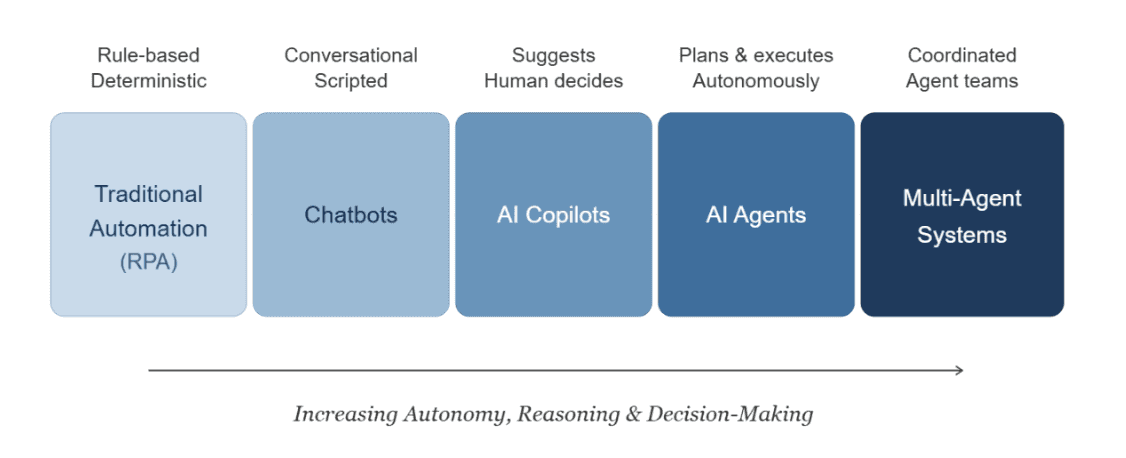
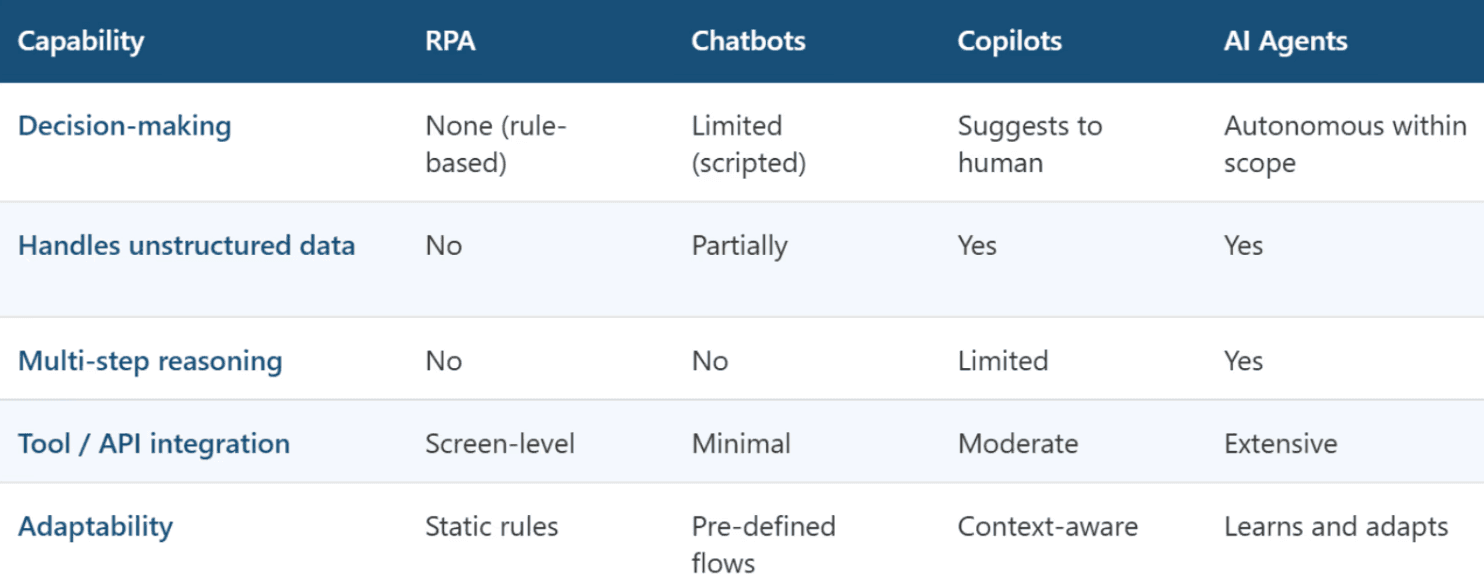
How agents compare to other types of technology
Understanding agentic workflows
An agentic workflow is a business process where AI agents handle the order of operations, decisions, and execution across steps. In a traditional automated workflow, every branch, condition, and action has to be programmed in advance, so for example, if something falls outside the script, the process tends to break due to how predefined it is. Agentic workflows are different because the agent can reason about what to do next, pick the right tool for the job, and adjust its approach based on what it finds along the way.
How an agentic workflow is structured
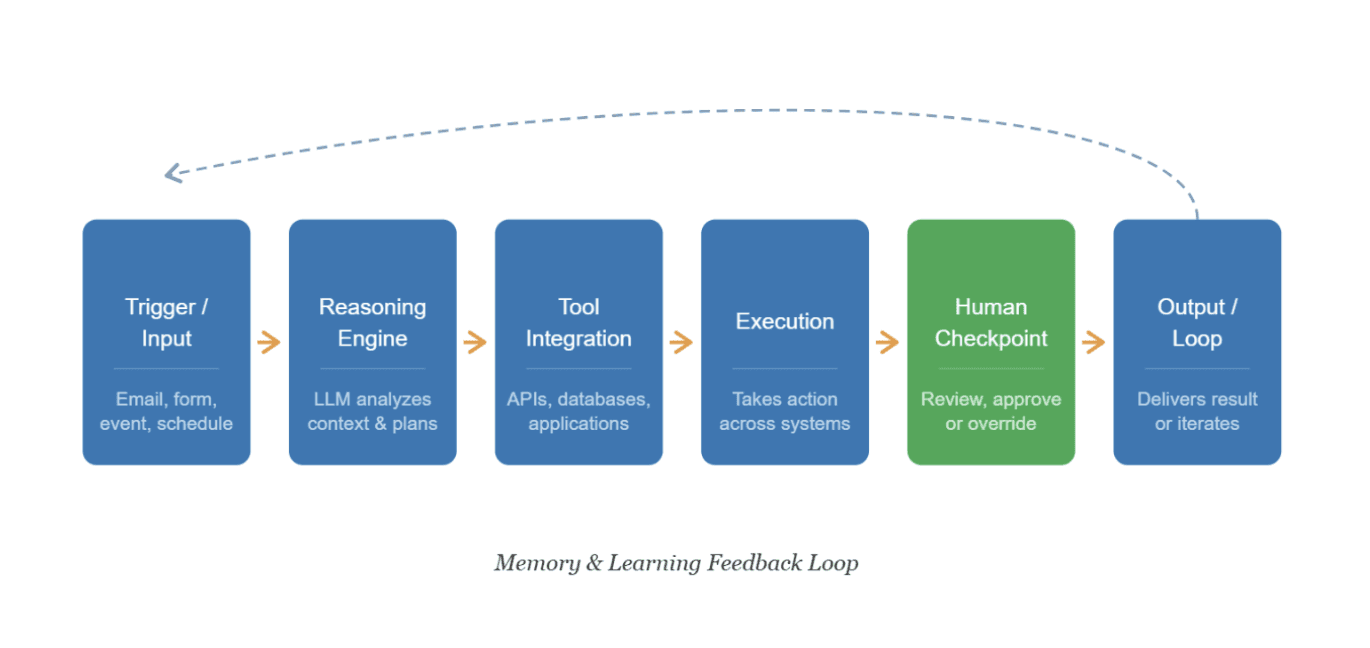
Most agentic workflows follow the same basic structure:
A trigger tends to start the process, such as an incoming email, a form submission, a scheduled time, or a signal from another process or system. Unlike traditional automation, the trigger does not need to be structured data since agents can read a natural-language email and figure out what to do with it.
The reasoning engine, usually an LLM, analyzes the input, understands what is being asked, and decides how to proceed. This part of the process is the part that many call “agentic” because the bot actually chooses the path to take to get to the finish line.
Through various integrations, the agent connects with external systems via APIs. These include CRMs, ERPs, databases, email platforms, and calendars. The reasoning engine then determines the appropriate tools and the order in which they'll be chosen.
Execution is where the agent actually does something: updates a record, sends a message, generates a document, or routes a ticket, with a single workflow that can span multiple systems.
Human checkpoints pause the workflow for review when the stakes are high, although each organization needs to set their own boundaries. Some organizations require approval on every action; others only flag exceptions.
Lastly, we reach either the final output, or loop it back into the LLM to iterate once again. Agents keep memory of what they have already done, so they can refine their approach across iterations.
A Concrete Example: Invoice Processing
For example, let’s take a mid-size company that processes 500 invoices a month. In the old workflow, someone manually checks each invoice against purchase orders, flags anything that does not match, emails it to a manager for approval, and then types the data into the ERP. In an agentic workflow, the agent receives the invoice, extracts the line items, validates them against the PO database, flags the exceptions for a human to review, and posts approved invoices straight to the accounting system. The routine invoices never require a person to touch them. Companies running agentic approaches on these kinds of workflows report up to 70% cost reductions.
The market landscape
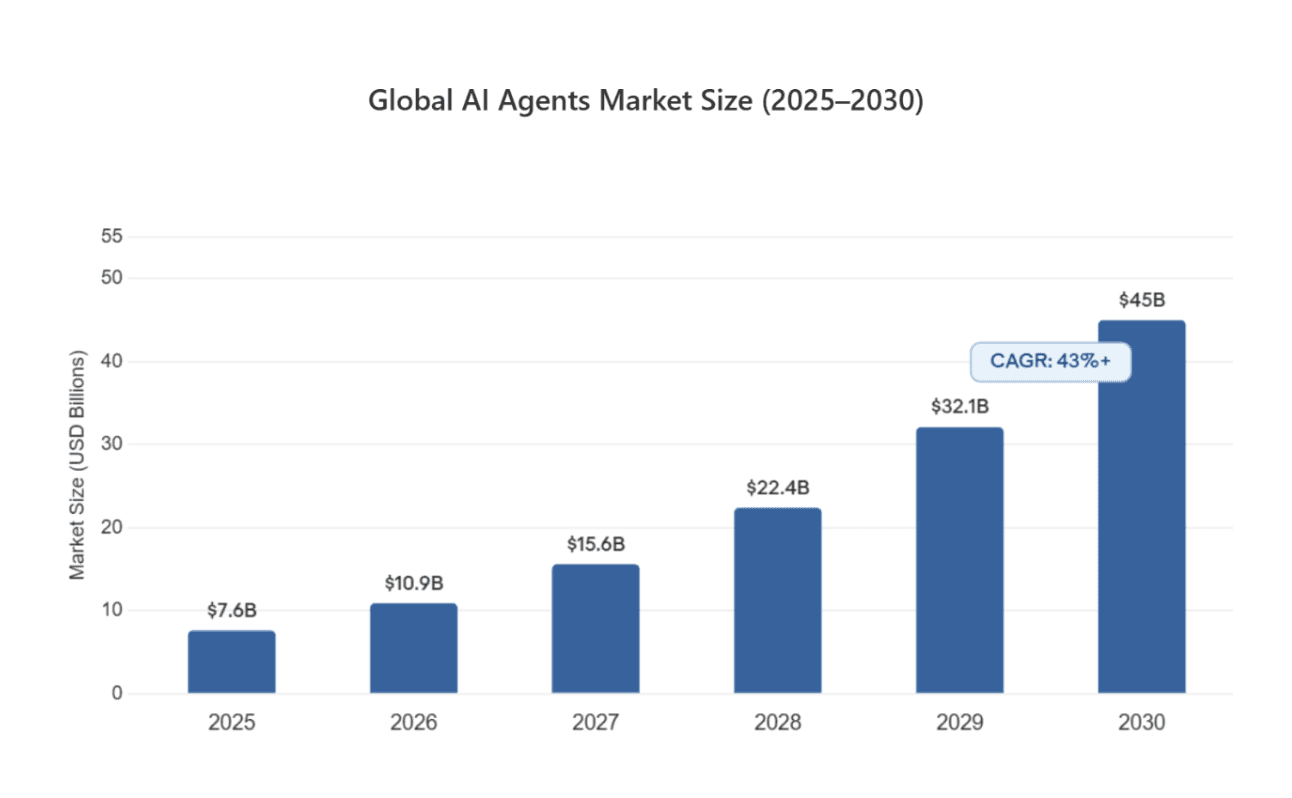
The industry numbers on AI agents are large and growing fast. The market went from $7.6 billion in 2025 to a projected $10.9 billion in 2026, and could reach $45 billion by 2030 if companies figure out how to orchestrate agents well.
Adoption is fast but not equal
A lot of companies are experimenting, while even fewer have agents running in production. G2's August 2025 survey found that 57% of companies had AI agents in production, 22% were in pilot, and 21% were still in pre-pilot. Gartner expects 40% of enterprise apps to embed task-specific agents by the end of 2026, up from under 5% in 2025.
The adoption rates also vary a lot by industry. The sectors processing the most repetitive, data-heavy work are moving fastest:
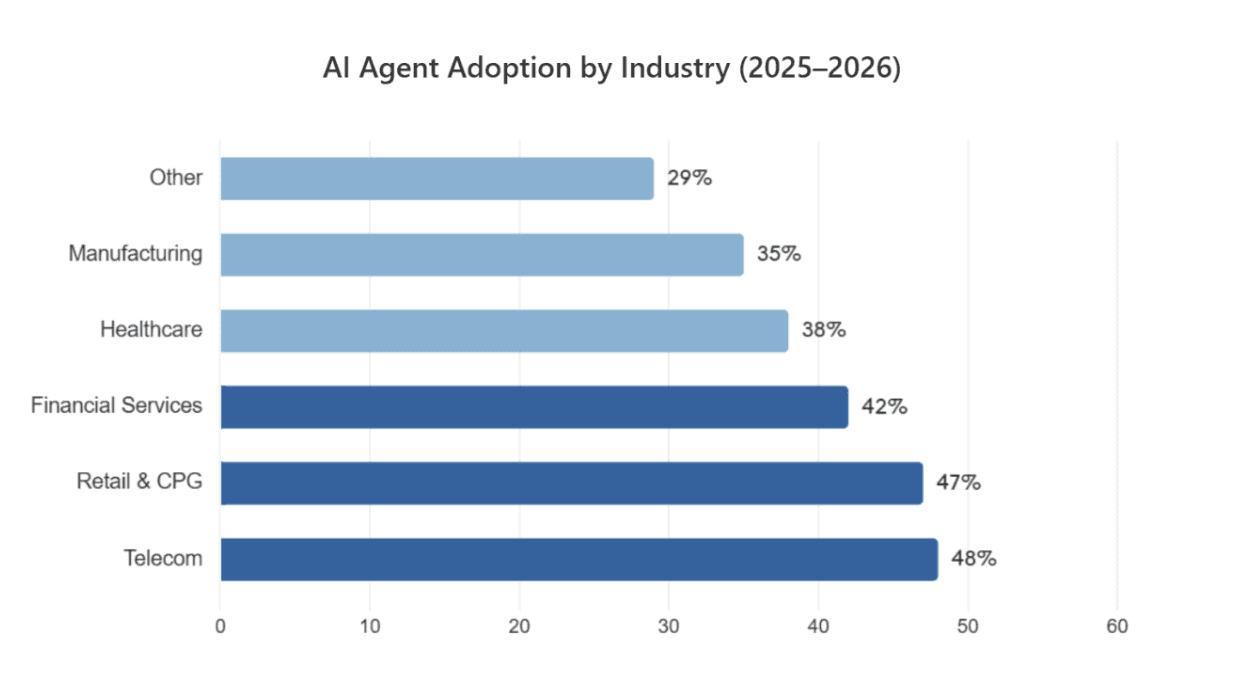
Telecom is at 48%, retail and consumer goods at 47%, and financial services at 42%, with those being active deployments. The share of enterprises exploring or piloting is higher still: 79% of organizations reported some level of agentic AI adoption as of late 2025.
The gap between interest and production-ready
Here is the uncomfortable part: nearly four in five enterprises say they have adopted AI agents in some form, but only about one in nine runs them in production at scale. The reasons are familiar: integration is hard, governance is immature, and getting a proof-of-concept to work is a very different thing from running it reliably across an organization. That gap between "we piloted it" and "it runs our process" is where most of the opportunity sits right now.
Where agents are being used today
AI agents are getting deployed across most business functions at this point. Here is where the data and case examples are strongest.
Customer service
This is the most common deployment area, and the ROI math is the simplest. Gartner predicts that by 2029, agentic AI will handle 80% of routine customer service issues without a human, cutting operational costs by 30%. The per-interaction economics are already stark: an AI-handled interaction costs $0.25 to $0.50 versus $3.00 to $6.00 for a human agent. Multiply that across thousands of daily interactions and the savings are hard to ignore for companies.
Sales and marketing
Agents are handling lead qualification, outreach sequencing, proposal drafts, and CRM data cleanup. Teams using agentic tools report producing content 46% faster and editing it 32% faster, which frees salespeople to spend time on actual selling with clients.
Operations and supply chain
Approval routing, order processing, compliance checks, and cross-department escalation are all common agent use cases in ops. Ecolab offers a good example: their site reliability team was dealing with about 30 daily performance alerts, and after deploying an AI agent to triage incidents, that number dropped to fewer than 10.
Finance and accounting
Invoice processing, expense categorization, reconciliation, and audit prep are strong fits, as finance workflows tend to be high-volume, rule-heavy, and built on structured data, which is exactly where agents perform best. Companies report up to 70% cost reductions on processing-heavy financial work.
Human resources
Candidate screening, interview scheduling, onboarding coordination, and benefits enrollment all involve repetitive steps that cross multiple systems. Agents can compress the time-to-hire and handle the administrative back-and-forth that bogs down HR teams.
IT and infrastructure
Automated incident triage, infrastructure monitoring, patch management, and service desk tickets are among the most mature agent use cases in IT. Gartner expects agents to handle first-line incident response across most large enterprises by 2026, with human operators focused on the complex problems.
The ROI case
The returns on agentic AI are outpacing earlier automation technologies by a wide margin, with the global average ROI sitting at 171%. In the U.S., enterprises report 192%, which is roughly three times what traditional automation delivers.
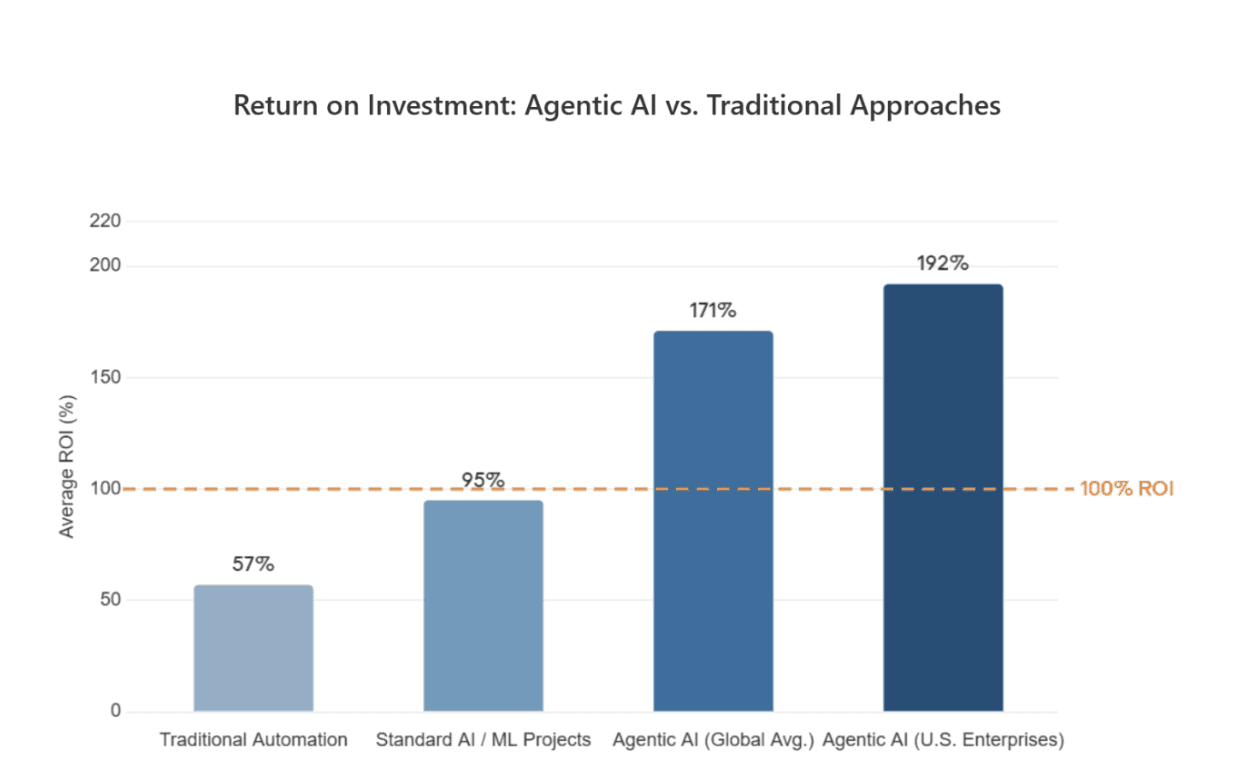
What stands out the most is the speed: 74% of executives say they hit positive ROI within the first year of production deployment, which is incredibly fast for enterprise technology. Agents are able to run around the clock, eliminate handoff delays between systems, and scale rapidly through additional agent creation versus having to hire more employees and training them up.
That said, the numbers are not equal across different approaches, as the best returns come from well-defined, repeatable workflows: customer service, order processing, back-office data work. Companies that point agents at vague or poorly documented processes tend to see weaker results, so it’s clear that how well you pick your use cases matters more than the technology.
62% of organizations expect to exceed 100% ROI, but getting there depends on disciplined scoping, clean data, working integrations with existing systems, and governance that keeps agents operating predictably.
Risks, challenges, and governance
The return on investment figures are there, but let’s not exclude the failures from the dataset. Based on Gartner’s June 2025 forecast, over 40% of agentic AI projects will be cancelled by the end of 2027 due to cost overruns, weak risk management, or unclear uses within the business.
What is blocking adoption
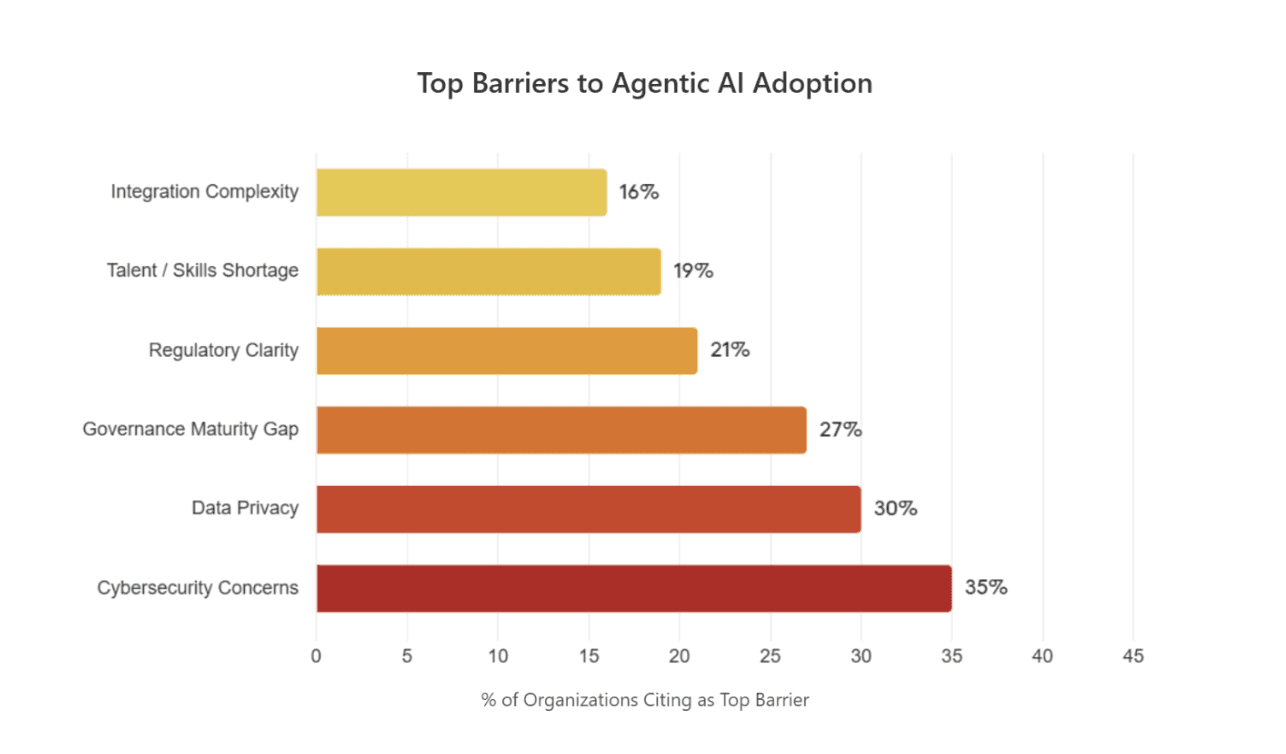
Most organizations are worried about cybersecurity, sitting at the top with 35%. This does fundamentally make sense, as agents need access to important systems to do their jobs, and every connection to these API tools is another hack waiting to happen. Furthermore, since organizations still don’t have a clear answer on what type of data is safe to provide, this creates the case for data privacy at 30%.
Most companies lack governance for what they are building
85% of companies say they plan to customize agents for their business, while only 21% have a mature governance model in place. Take a second to read that again. The vast majority of enterprises are deploying autonomous software without clear rules for who is accountable when something goes wrong, how decisions are audited, or how agents are monitored in production. Gartner says this governance gap is the primary reason so many projects will stall.
Watch out for "agent washing"
Gartner created the term known as "agent washing", which describes vendors rebranding their existing chatbots and automation tools as "agents" without adding real agentic capability. When evaluating platforms, the question to ask is whether the product can actually reason through multi-step problems, use external tools, and adapt based on results. If the answer is no, it is most likely a chatbot rebranded with a new name.
Human oversight still matters
Agents running without guardrails create real liability. Gartner's October 2025 predictions flagged rising legal claims related to autonomous AI decision-making, with the trend expected to accelerate through 2026. The practical approach is graduated autonomy: start with workflows where agents recommend and humans approve, then widen the boundaries as the system proves it can be trusted.
What is ahead: 2026 to 2030
We are still early in the rise of agents and agentic workflows, with most companies running a handful of agents on isolated use cases. The next few years will be about scaling, coordinating, and governing these systems across the enterprise. Here are some of the trends worth keeping your eye on as you look towards the power of AI.
Multi-agent orchestration
The average organization currently runs about 12 agents, and Salesforce projects that number will climb 67% within two years. Once you have dozens of agents, the hard problem changes: it is no longer "how do I build an agent?", rather, it is "how do I get 30 agents to work together without stepping on each other?" Deloitte projects the market could reach $35-45 billion by 2030, but the higher end is only achievable if companies solve the orchestration issue. Right now, half of all deployed agents run in silos, disconnected from each other.
The agent manager role
Harvard Business Review described a new job title in February 2026: the agent manager. It is someone who defines what agents should do, reviews their work, handles the exceptions they cannot, and tunes workflows based on real results. The interesting finding is that domain expertise matters more than AI knowledge for this role, so for example, if the agents are running finance workflows, you want someone who knows finance. HBR expects "agent manager" to be a standard job title within 18 months.
From human-in-the-loop to human-on-the-loop
Today, most agent deployments require a human to approve each action. The next step is "human-on-the-loop" where agents execute within defined boundaries and humans only step in for exceptions. Deloitte says the most advanced companies will start making this shift in 2026. It requires better monitoring tools, clearer escalation rules, and a track record of agents behaving predictably.
Industry-specific agents
Gartner predicts that 33% of enterprise software will include agentic AI by 2028, up from under 1% in 2024. That will bring pre-built agents designed for specific verticals, for example: healthcare compliance, financial reporting, and supply chain logistics. Companies that build internal agent expertise now will have an easier time integrating and governing these industry-specific tools as they arrive.
Explore More Reports
Discover additional insights and strategies across AI, growth, and M&A.