
The Illusion of Digital Adoption
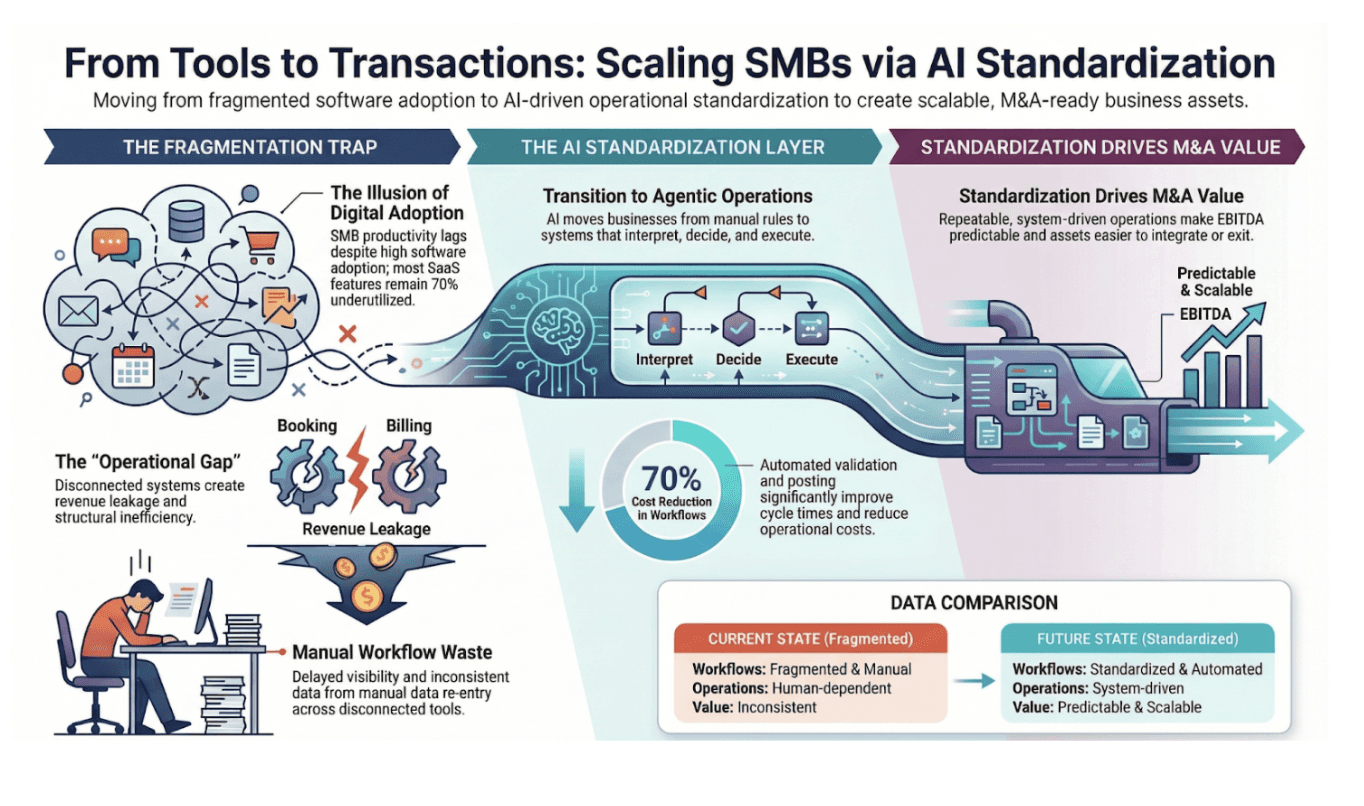
Over the past decade, small and medium-sized businesses (SMBs) have rapidly adopted software tools across nearly every function: payments, booking, CRM, inventory, and accounting.
On the surface, this looks like digital transformation. In reality, it is not.
Industry research from McKinsey & Company shows that while SMBs have increased software adoption, productivity gains have lagged significantly behind. Similarly, studies from Gartner indicate that a large portion of SaaS capabilities remain underutilized, often below 30% of available functionality.
The issue is not access to tools.
The issue is how these tools are used, or more accurately, not used.
The Operational Gap
Today’s SMB stack is typically fragmented.
Booking, billing, payments, and accounting systems operate across disconnected platforms, requiring manual coordination between workflows.
Research from Deloitte highlights that lack of system integration remains one of the primary barriers to operational efficiency in SMB environments. Similarly, SMB-focused insights from Intuit show that businesses often rely on multiple disconnected tools, leading to duplicated workflows and inconsistent data.
As a result, most SMBs are not optimized for outcomes whether that is revenue per unit, utilization rate, or margin expansion
The gap is widely documented in productivity studies by the OECD.
What Does This Actually Look Like?
A typical SMB workflow today:
Customer booking
manually logged into system
invoice generated separately
payment reconciled later
data re-entered into accounting
reporting done end-of-month
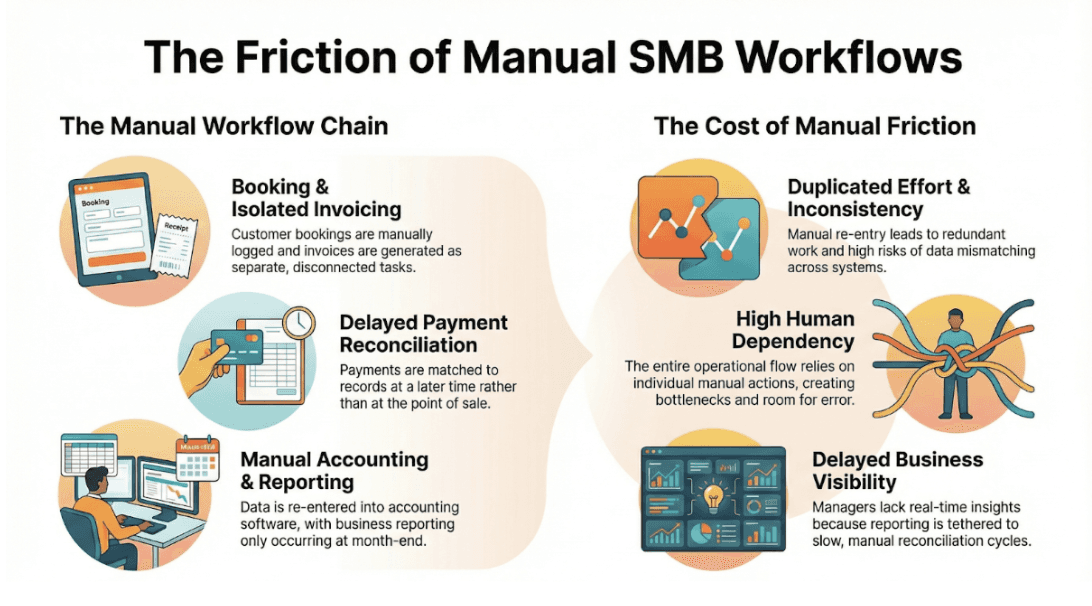
This creates:
duplicated work
human dependency
delayed visibility
inconsistent data
The result is not just inefficiency, it is structural revenue leakage and margin compression.
The Operational Shift: From Tool Adoption to Operational Transformation
The next phase of transformation is not about adding more software. It is about restructuring how operations run.
Across SMBs, the problem is consistent:
Tools exists, but the workflows are not connected
Data exists, but is not usable in real time
Decisions are still made manually
This gap shows up clearly in usage patterns. Which refers back to the findings from Gartner and McKinsey & Company earlier, consistently showing that SMBs typically use only a fraction of the functionality in tools they already pay for, often below 30%. The constraint itself is not the access but the execution.
With AI, the level of system intelligence shifting from:
Task-level automation to workflow level automation
Disconnected tools into integrated systems
Human coordination to system coordination
With that being said, AI is now enabling SMBs to realize full workflow orchestration all at once instead of digitizing individual steps. This shift is critical because operational standardization is what makes businesses scalable and investable.
From Automation to Agentic Operations
Traditional automation relies on predefined rules.
AI-driven systems (agents) operate differently, they can:
interpret inputs (e.g. invoices, emails, bookings)
decide next steps
execute across multiple systems
iterate based on outcomes
A simplified workflow becomes:
Trigger → Reasoning → Tool Selection → Execution → Feedback Loop
Example: Invoice Processing
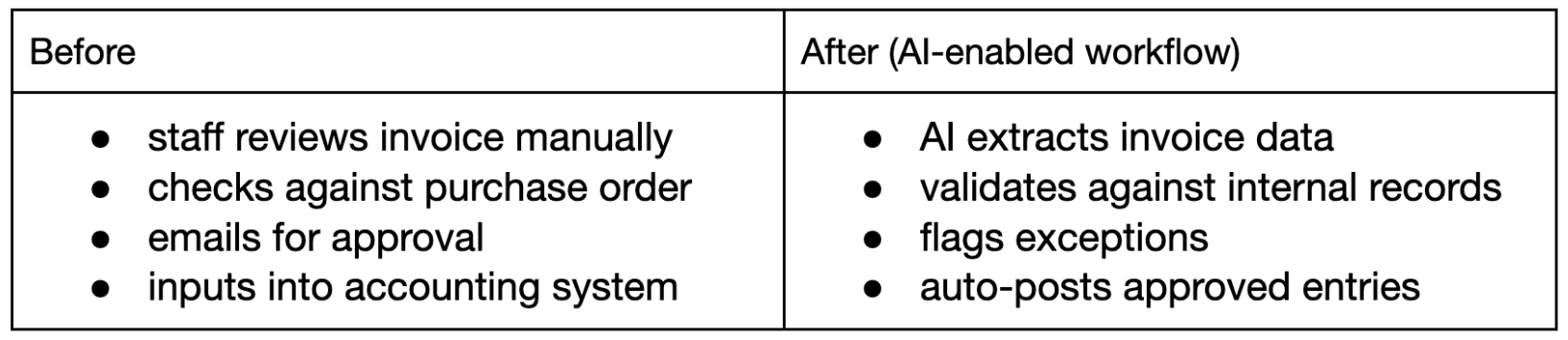
In these workflows, companies report up to 70% cost reduction and significant cycle time improvements.
The Real Insight: AI as a Standardization Layer
This shift is often misunderstood as “automation.” In reality, something more important is happening:
AI is standardizing how work gets done
When workflows become repeatable, system-driven, and consistent across locations,they become:
measurable
comparable
transferable
Dental Clinics Industry: From Fragmented Practices to Scalable Platforms
The dental industry provides a clear real-world precedent.
Over the past decade, private equity firms have aggressively consolidated independent dental clinics into Dental Service Organizations (DSOs).
According to data from PitchBook and industry insights from the American Dental Association, DSOs have grown rapidly by aggregating fragmented practices and implementing standardized systems across locations.
The value creation model is consistent:
Centralized booking and patient management
Standardized billing and insurance workflows
Shared procurement and cost optimization
Performance tracking across clinics
Once standardized, these businesses become significantly easier to scale, benchmark, and exit.
This model is now extending beyond dental into physiotherapy, veterinary clinics, and other service-based SMB sectors.
Grocery Retail: A Real-Time Operational Gap
The same pattern is visible in independent grocery stores.
A typical store operates across:
POS system
supplier ordering (often via WhatsApp, phone, or distributor portals)
manual inventory checks
spreadsheet-based accounting
There is no unified system.
A standard workflow looks like:
inventory runs low → staff manually checks shelves → order placed with distributor → delivery arrives → inventory updated later → reconciliation done weekly or monthly
This creates:
stockouts and over-ordering
delayed inventory visibility
pricing inconsistencies
cash flow inefficiency
In Ontario alone, the grocery market is highly fragmented, with hundreds of independent operators running on low digital maturity systems.
This is not a technology problem. It is an operational design problem.
When these workflows are standardized:
inventory becomes real-time
reordering becomes automated
margins become measurable
At that point, the business becomes:
easier to benchmark
easier to optimize
easier to acquire
This is the same transformation pattern seen in dental, applied to retail.
Why Standardization Drives M&A Value
Operational transformation directly impacts valuation.
According to Bain & Company, a significant portion of EBITDA growth in mid-market private equity investments comes from operational improvements and margin expansion.
Similar findings from Boston Consulting Group and McKinsey & Company reinforce that value creation increasingly comes from operational excellence rather than financial engineering alone.
When operations become standardized:
EBITDA becomes more predictable
Assets become comparable
Integration becomes repeatable
Reducing execution risk for buyers and turning fragmented SMBs into scalable platforms and ultimately, acquisition targets.
Standardization closes that gap.
The Emerging Opportunity: AI as the Standardization Layer
This is where AI becomes strategically important.
Not as a tool layer but as an operational layer.
Instead of selling software subscriptions, the opportunity lies in:
embedding AI into daily workflows
automating decision-making processes
unifying fragmented systems
creating repeatable operational models
AI is no longer a feature but an institutional-graded infrastructure.
Market Context: A Shift in Deal Activity
This operational shift is already reflected in market activity.
MCA’s internal analysis of approximately 2,000 transactions across AI, fintech, and infrastructure sectors between 2024 and 2026 shows that deal volume has more than doubled over the period
driven in part by increasing demand for scalable, operationally efficient businesses.
Rather than acquiring raw growth, buyers are increasingly targeting businesses that can be integrated, optimized, and scaled.
The Gap Between Adoption and Real Transformation
Despite strong momentum, most SMBs have not crossed the operational threshold.
They have:
adopted tools
experimented with automation
tested AI in isolated use cases
But they have not:
restructured workflows end-to-end
unified systems across functions
embedded decision-making into operations
This creates a clear divide:
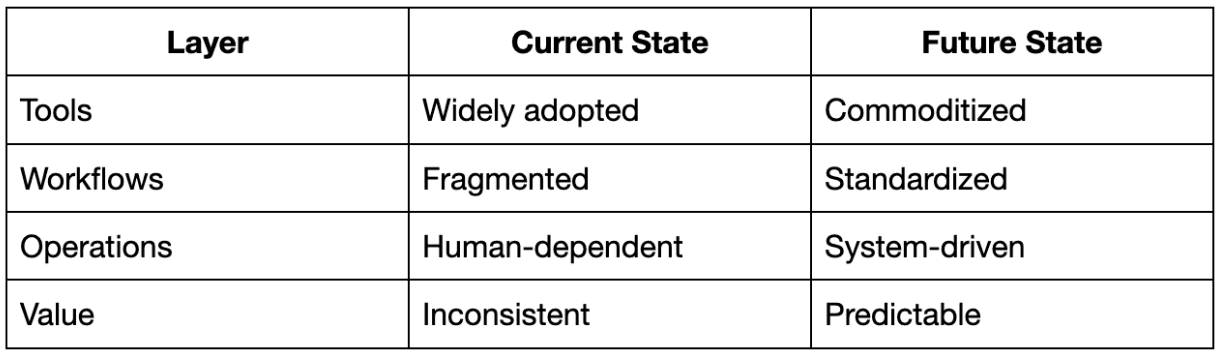
The winners will not be those who adopt AI tools but those who rebuild operations around them.
Why Most SMB Transformations Will Fail
Most AI implementations will not deliver meaningful results. Not because the technology is immature but because the operating model is.
Failures typically follow three patterns:
1. Undefined workflows
AI is applied on top of unclear or inconsistent processes.
This leads to automation of inefficiency.
2. System fragmentation
Tools are added without integration.
This increases complexity rather than reducing it.
3. Lack of operational ownership
There is no clear definition of:
decision boundaries
exception handling
system accountability
As a result, companies deploy AI but do not achieve operational leverage. The output improves slightly. The system does not.
The Real Opportunity: Owning the Operational Layer
This is where the opportunity becomes strategic.
The highest-value position is not at the tool layer but at the operational layer that connects everything together:
Tools → Workflows → Financial Outcomes
Most players operate here:
SaaS vendors: tools
Agencies: implementation
Consultants: strategy
But the missing layer is end-to-end operational transformation.
MCA Positioning: From Advisory to Execution Layer
This is where MCA can differentiate. Not as a tool provider nor a generic AI consultant but as an operational upgrade partner for fragmented industries.
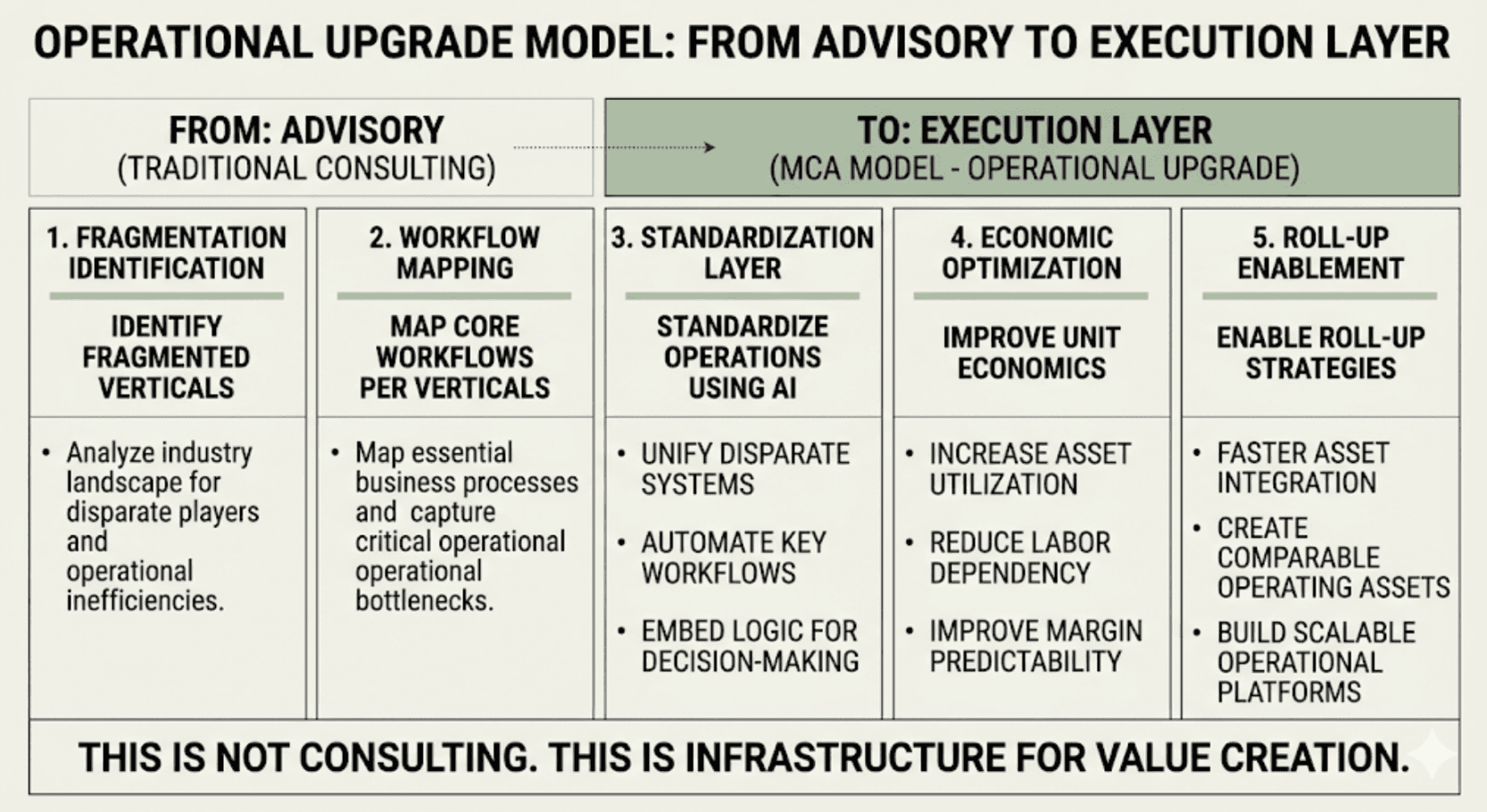
Most advisory models stop at identifying problems and recommending solutions. They map fragmentation, outline workflows, and produce strategy decks.
But value is not created at the advisory layer. It is created at the execution layer.
MCA’s model moves beyond diagnosis into operational transformation:
identifying fragmented verticals
mapping core workflows
standardizing operations through AI
optimizing unit economics
enabling scalable roll-up strategies
This is not a linear consulting process. It is a system for turning fragmented businesses into integration-ready, scalable assets.
MCA is beyond consulting and it is the infrastructure for value creation.
The Long-Term Shift: From Businesses to Systems
What is happening is bigger than AI adoption.
We are moving from owning businesses to owning systems that run businesses.
Historically, value equals location + customer base; now, value equals operational system + scalability.
This changes how:
businesses are valued
acquisitions are executed
portfolios are scaled
Conclusion
Most people ask: “How can AI make this business more efficient?”
The better question is: “How can this business run without human coordination?”
Because once operations become system-driven:
growth becomes repeatable
integration becomes seamless
margins becomes predictable
It makes businesses scalable and this is what makes them acquirable.
The next wave of M&A will not be won by aggregation but by ownership of the systems behind the assets.
Explore More Reports
Discover additional insights and strategies across AI, growth, and M&A.